

Last week, I was watching a YouTube video on the subscription economy, how everything from basic softwares to even cars is now all based on subscription model, then something hit me, what about forgotten subscriptions?
Here’s a thought experiment. Right now, without peeking at your bank statements or opening your banking app, just off the top of your head, how much do you think you’re spending on subscriptions each month?
Take a moment.
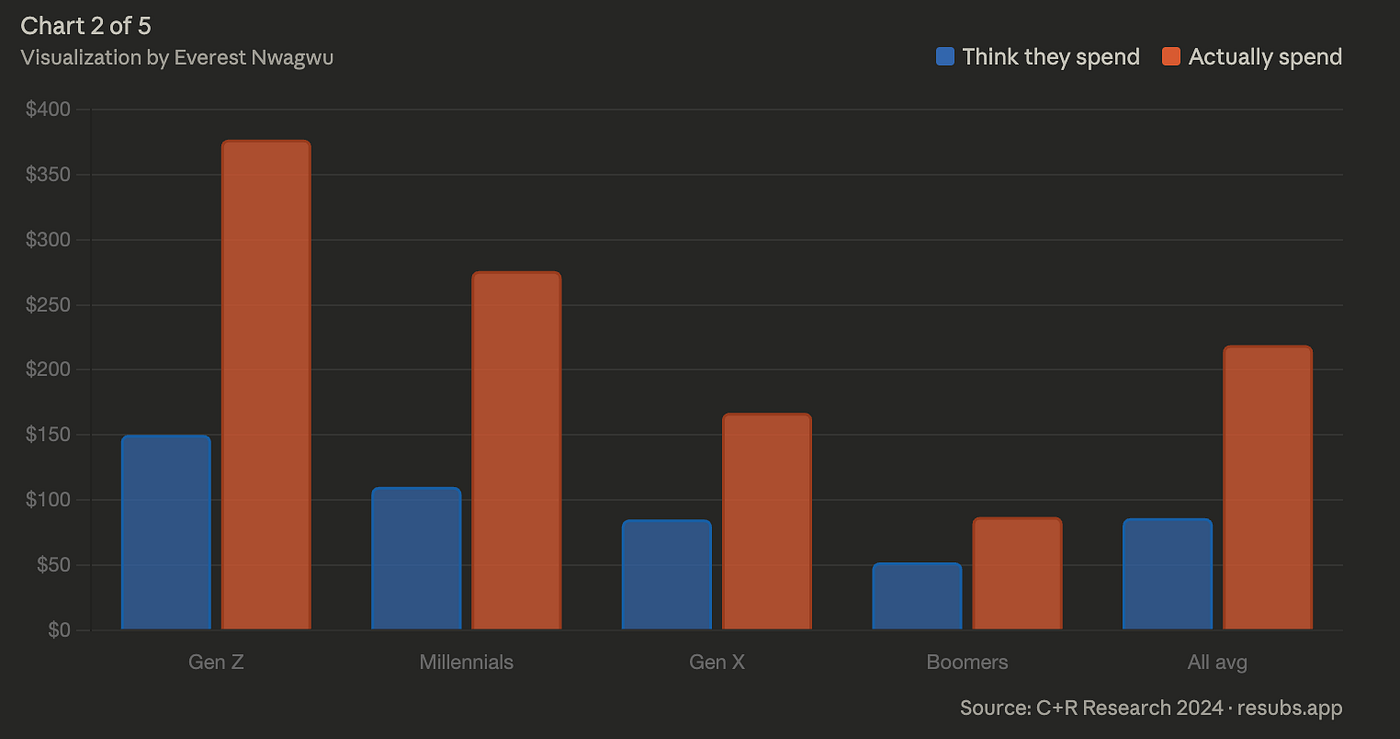
If your answer landed somewhere between $50 and $100, you’re in very good company. You’re also, almost certainly, completely wrong. Research from C+R Research found that the average person thinks they spend around $86 a month on subscriptions. The actual figure? $219. That’s a gap of $133 every single month, or $1,596 every year.
That number probably feels surprising. Maybe even a little embarrassing. But here’s the thing, it shouldn’t. Because the system isn’t broken. It’s working exactly as designed.
Welcome to the billion-dollar business of forgetting to cancel.
A Business Model Built on Autopilot
Remember when a company offers you “FREE’ subscription, but you need to enter your card details first, that’s the main trap.
The subscription economy is one of the most consequential shifts in modern commerce. What started as a sensible way to pay for newspapers and milk deliveries has evolved into the dominant business model of the digital age, covering everything from Netflix and Spotify to gym memberships, meal kits, cloud storage, meditation apps, pet food, razor blades, and software tools you downloaded once during lockdown and haven’t opened since.

Over $30 billion a year flows from what researchers at Yahoo Finance called “accidental subscriptions”. services people forgot to cancel, free trials they never meant to convert, and charges buried so deep inside confusing account menus that 42% of consumers stay subscribed simply because cancellation feels like too much effort.
As financial planner Douglas Boneparth, CFP at Bone Fide Wealth, put it: “It’s a slippery slope with subscriptions because it just happens automatically and you’re not actively making that purchase every month.”
That passivity is the product. And it’s worth tens of billions of dollars a year.
The Scale of the Problem
Let’s start with the numbers, you know I love my data, not just because i love numbers and data (which I do), but because they’re genuinely eye-opening.
According to Whop’s 2026 Subscription Statistics report, the global subscription economy was worth $3 trillion in 2024. Even if you look only at the subscription e-commerce segment, a narrower slice of the market, Grand View Research, cited by Yahoo Finance, puts that figure at $492 billion in 2024, projected to balloon past $1.5 trillion by 2033. Subscription businesses have grown five times faster than S&P 500 companies over the past decade, according to Marketing LTB. Seventy-eight percent of adults worldwide now hold at least one paid subscription, and the average consumer juggles 5.6 active subscriptions at any given time, though surveys consistently suggest people undercount when asked, surprise!.
In the UK, the story is same, according to data cited by World Finance, around 10 million of the UK’s 155 million active subscriptions are entirely unwanted, costing consumers £1.6 billion a year just in charges people actively don’t want, let alone the broader category of services they’ve simply stopped using.
Why Our Brains Are Terrible at Tracking This
It would be easy and a little unfair for me to write all this off as people being careless with their money. The reality is considerably more interesting, and considerably more forgiving of human nature.
Our brains are simply not wired to track recurring small charges across multiple accounts, payment methods, and billing cycles. A 2024 academic study on subscription fatigue, published at ICOFE-2024 and cited in World Finance, identified three core psychological triggers that cause people to lose track of what they’re paying for: a lack of perceived value, hidden or unpredictable fees, and a creeping sense of lost control. These aren’t character flaws. They’re predictable human responses to a system deliberately structured to exploit cognitive limitations.
The Generation Gap Nobody Expected
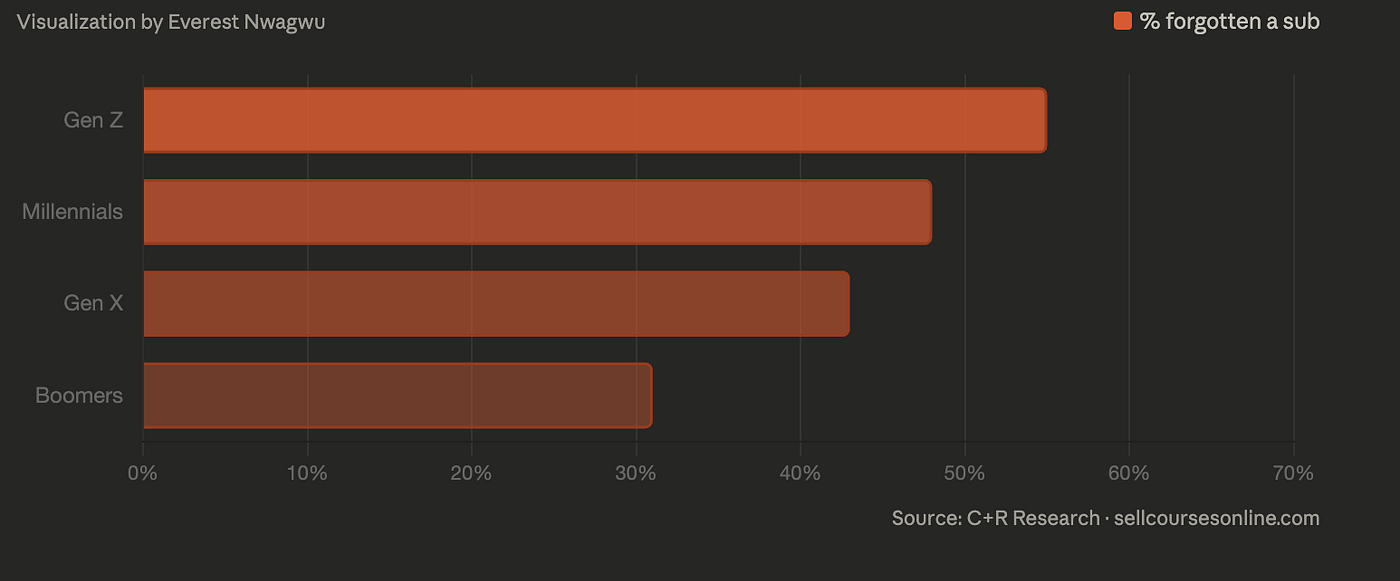
Here’s something counterintuitive: it’s not older generations who are most likely to forget their subscriptions. It’s younger people, yes, who would have thought right?.
According to C+R Research data compiled by sellcoursesonline.com, Gen Z leads the pack, with 55% having forgotten a paid subscription at some point. Millennials come in at 48%, Gen X at 43%, and Boomers, who tend to have fewer subscriptions overall, fare best at 31%.
Part of this is simply volume. Gen Z subscribes to more services than any other generation, spanning streaming platforms, gaming subscriptions, app-based services, social media tools, and digital products. According to analysis by resubs.app, Gen Z spends an average of $377 per month on subscriptions, more than four times the $87 per month that the average Boomer spends.
More subscriptions mean more things to track. More things to track means more things to forget. The generation most fluent in digital services is also, paradoxically, the most vulnerable to subscription creep.
Who Actually Profits And How
Let’s be direct about the economics here, because they explain everything.
Zuora, the company that coined the term “subscription economy” and now runs the Subscription Economy Index tracking over 500 businesses, has reported that companies using this model have experienced 435% growth over nine years, according to sellcoursesonline.com. Their compound annual growth rate of 16.5% utterly dwarfs the S&P 500’s 4.8% over the same period.
Retention is the product. And friction around cancellation is, by design, a feature of that retention strategy.
This is why an entire industry of counter-services has grown up around the problem. Apps like Rocket Money (formerly Truebill), SubBuddy, ReSubs, and JustCancel exist entirely because the subscription management problem is large enough to support businesses dedicated solely to finding your forgotten charges and helping you cancel them. The fact that these services are themselves subscription-based — and thriving — tells you something about both the scale of the problem and the somewhat circular nature of the solution.
What You Can Actually Do About It
Start with a bank statement audit. Pull your last three months of statements across every card, account, and payment method you use. Sort by recurring charges.Flag everything you don’t immediately recognise.
Categorise ruthlessly. For each subscription you identify, put it in one of three buckets. Essential for instance, you use it regularly and would genuinely miss it if it disappeared. Be honest with yourself about the Nice-to-have tier.
Use the tools that exist for exactly this purpose. Rocket Money, SubBuddy, ReSubs, and JustCancel can connect to your accounts and automatically surface every recurring charge, often spotting things manual audits miss.
Set a subscription budget and stick to it. A practical rule of thumb from resubs.app: spend no more than 5% to 10% of your monthly take-home pay on subscriptions in total. On a £3,000 monthly take-home, that’s £150 to £300. If you’re over that ceiling, something needs to go.
Know your rights. In the UK, the Consumer Rights Act gives you tools to challenge unexpected auto-renewals, and the ongoing government consultation on subscription traps may strengthen those protections further. In the US, California and New York have strong auto-renewal laws at the state level, even without the FTC’s Click-to-Cancel rule. In the EU, the Digital Services Act provides broad protections against dark patterns. If you believe you’ve been unfairly charged, report it to the FTC at ReportFraud.ftc.gov in the US, to your national consumer authority in Europe, or to Citizens Advice in the UK.
The Bigger Picture
The subscription economy is not inherently predatory. When it works, when a streaming service delivers content you genuinely love, when a software tool saves you hours every week, when a subscription means you never run out of something essential, it’s a genuine improvement on what came before. Predictable costs, consistent access, no ownership headaches. There’s real value there.
But the data makes one thing undeniable: a significant portion of subscription revenue is extractive rather than value-creating. Over $30 billion a year in accidental subscriptions. £25 billion wasted annually in Britain alone. The average consumer underestimating their spending by $133 a month. Seventy-six percent of subscription services deploying at least one dark pattern designed to make cancellation harder than it needs to be.
The subscription economy promised us convenience. What it delivered, in too many cases, was a sophisticated and carefully designed system for extracting money from our distraction.
If you read to the end, thank you for reading and connect with me on all social platforms Everest Nwagwu or email hello@everestnwagwu.com
N:S: Written after watching the hilarious film, Balls Up.